Trolley Jack vs Floor Jack: Which Is Better? (November 2026)
In a trolley jack vs floor jack comparison, the names often mean the same wheeled hydraulic tool. Choose by clearance, usable lift height, capacity and access to your vehicle’s approved lift points.
On this page (9 sections)
- Trolley jack vs floor jack: what is the difference?
- Which measurements decide whether a jack fits?
- How much capacity do you need for your vehicle?
- Which of these 3 jacks should you consider?
- How should you set up a trolley or floor jack?
- Which common mistakes should you avoid?
- How do you care for a hydraulic floor jack?
- FAQ
- Trolley jack vs floor jack: which should you choose?
A trolley jack is usually a type of floor jack, so a trolley jack vs floor jack comparison is mainly about the exact tools, not two separate lifting systems. Choose by vehicle clearance, lift height, capacity and access to approved lift points.
For occasional work on a compatible lighter car, the DNA Motoring may cover your needs. The AV Steel offers more lift height, while the SATA suits a garage where a heavy jack can stay on the floor.
Start with your vehicle manual and the job you need to do. A jack that slides underneath the car can still fall short when you try to raise it onto stands.

 Best for occasional car maintenance
DNA Motoring 2 Ton Low Profile Trolley Jack
Trolley jack vs floor jack: what is the difference?
The names commonly describe the same rolling hydraulic design. “Trolley jack,” “floor jack” and “service jack” overlap across brands and regions, so none guarantees a particular capacity or size.
These tools use a hydraulic mechanism to raise a lifting arm and saddle. Wheels let you position the jack and allow it to move as the lifting arm changes angle.
Some shoppers use “trolley jack” for a smaller portable tool and “floor jack” for a larger garage model. Treat that as informal wording, since a product name does not set its limits.
A useful comparison puts the actual measurements side by side. A smaller jack may be easier to carry but lack height, while a larger model may need more room beneath the vehicle and around the handle.
Does trolley jack vs floor jack wording tell you which is stronger?
No, the rated capacity controls the lifting limit. Steel construction, a large frame or a long handle cannot replace that rating.
Likewise, “low profile” does not guarantee access beneath a lowered car. Confirm the entry height and the shape of the frame along the route to the lift point.
Which measurements decide whether a jack fits?
Check entry height, reach and maximum lift before buying. All 3 must suit the same approved lift point, rather than different convenient spots beneath the car.
Measure on a hard, level surface with the vehicle in its normal condition. Use the manual to identify the lifting point before taking measurements.
Entry height and access beneath the body
The saddle must fit beneath the lift point, and the rest of the jack must clear anything along the way. A low nose is not enough if a taller section of the frame meets a sill or bumper.
Leave room to position the tool without scraping the car. If clearance is tight, read what a low profile floor jack is before narrowing your choices.
A flat tire can reduce the available clearance further. If emergency wheel changes are part of your plan, account for that situation and follow the vehicle’s roadside lifting instructions.
Reach and handle space
A jack must reach the approved point without placing its saddle against nearby trim or an unapproved part. Overall length alone does not tell you how far the saddle reaches beneath a vehicle.
Check that you can move the handle through its working arc. A wall, parked vehicle or low bumper can make an otherwise suitable jack awkward to operate.
Maximum lift and stand height
Maximum saddle height is not the same as clearance beneath the vehicle. Suspension movement can use part of the lift before a tire leaves the ground.
For stand-supported work, the jack must raise the vehicle enough to position the stands at an approved working height. Check this relationship before buying either item, especially for vehicles with long suspension travel.
How much capacity do you need for your vehicle?
Follow the vehicle and jack manufacturers’ requirements for the planned lift. Do not assume a jack carries exactly half the vehicle’s weight at an axle or one quarter at a corner.
Weight distribution and the chosen lifting point affect the load. Passenger cars, SUVs and pickups also vary too much for body style alone to decide capacity.
An overload valve is a backup feature, not a way to judge whether a load is acceptable. Stop if the vehicle or job falls outside the jack’s stated limits.
Our guide to choosing the right floor jack size explains the checks. For taller vehicles, compare floor jacks for trucks and SUVs with your required lift height and reach.
Which of these 3 jacks should you consider?
Choose the AV Steel for extra lift height, the DNA Motoring for compatible lighter-car jobs, or the SATA for a fixed garage setup. Each has a different reason to buy, and each has a clear reason to skip it.
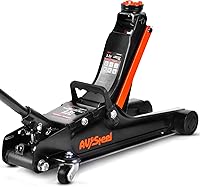
AV Steel 3 Ton Low Profile Floor Jack
The AV Steel combines a 3 ton capacity with a 19-7/8 in maximum lift, the highest in this group. Its dual piston pump reduces handle strokes, and rotating rear wheels help you position its steel frame.
It is the first option to consider if one garage jack needs to cover several compatible vehicles. The extra height is useful when your planned support position is beyond the DNA Motoring’s range.
Skip it for a low car until you resolve its conflicting minimum-height figures with AV Steel. Also check access to each vehicle’s lift points rather than assuming one successful fit covers the whole garage.
Its 360° rotatable saddle helps with positioning, but the contact surface still must suit the approved point. Do not use saddle rotation to compensate for an off-center or angled lift.
DNA Motoring 2 Ton Low Profile Trolley Jack
The DNA Motoring offers a 2 ton capacity and a 5.1–13 in lifting range. Its steel frame, swivel casters and overload release valve cover the core features needed for a suitable lifting job.
It makes sense for occasional maintenance on a compatible lighter car when you have already confirmed the required height. At 9.66 kg, it is lighter than the SATA, which matters if carrying the tool is part of every job.
DNA Motoring’s guidance limits vehicle weight to 4,000 lb and excludes pickup trucks and large SUVs. Skip this model for those vehicles rather than trying to justify it through an estimated corner load.
Also skip it if the saddle cannot start beneath your lift point or finish high enough for your stands. A smaller jack becomes a poor choice when it forces a workaround every time you use it.
SATA 3 Ton Ultra Low Profile Steel Floor Jack
The SATA has a 3 ton capacity, a 19-1/8 in maximum lift and a dual piston pump. Its slow-release system is designed to help control lowering as you transfer weight onto stands or return the vehicle to the ground.
This model suits a permanent garage setup better than a routine carry-in tool. Its 70 lb weight is less of a burden when you can roll it between storage and the work area.
Skip it if you need to carry a jack up steps or load it into a vehicle regularly. Low-car buyers should also resolve its conflicting minimum-height figures with SATA before committing.
The release system still needs careful operation. Follow SATA’s instructions and watch the vehicle’s contact with both stands as the load transfers.
How should you set up a trolley or floor jack?
Prepare the surface, support equipment and lift points before raising the vehicle. A clear setup lets you focus on saddle contact rather than searching for tools with the car raised.
- Park on a hard, level surface that meets the equipment instructions. Avoid gravel, soft ground and slopes.
- Follow the vehicle manual for parking brake, transmission and wheel-chock placement. Keep people clear of the work area.
- Inspect the jack for leaks, damage, loose parts and wheels that do not move freely. Do not use damaged equipment.
- Identify separate approved lifting and support points. Plan where the stands will go before placing the saddle.
- Position the saddle squarely beneath the lift point. Check contact again as it begins to take the load.
- Raise only as directed, then lower onto correctly rated stands before working underneath. Confirm secure support according to the stand instructions.
Keep the jack’s wheels free to roll as the lifting arm moves. Do not brace the frame against an obstacle or pull the car sideways with the jack.
A stand location may differ from the lifting location, so plan around both. Read how many jack stands you need if your task requires supporting more than one corner.
Which common mistakes should you avoid?
Avoid improvised height, blocked wheels and rushed load transfers. These mistakes can undo an otherwise sensible jack choice.
Do not stack loose blocks beneath a jack or on its saddle to make up missing height. Choose equipment that reaches the required position using only manufacturer-approved accessories and methods.
Do not lift from a convenient-looking panel or suspension part without approval in the vehicle manual. A strong-looking surface may be unsuitable for concentrated lifting force.
Keep hands clear of pinch points, and never go underneath while the vehicle rests only on the jack. A hydraulic tool lifts the load; stands provide support for the work.
When lowering, open the release control gradually as directed. Watch for uneven stand contact, and stop if the vehicle shifts or the saddle moves out of position.
How do you care for a hydraulic floor jack?
Keep it clean, inspect it before use and follow its maintenance schedule. Store it with the lifting arm lowered and protect it from moisture as the manufacturer directs.
Wipe away dirt that could hide leaks or interfere with moving parts. Check wheels, casters and fasteners, and lubricate only the points specified in the instructions.
Use the hydraulic fluid the manufacturer requires. Our guide to floor jack oil explains why substituting unrelated automotive fluids can cause problems.
A spongy action or failure to reach normal height may require attention to air or fluid levels. Follow the model’s procedure and consult how to bleed a floor jack for the basic process.
Do not adjust an overload valve to increase capacity. Stop using a jack that leaks, lowers unexpectedly or behaves abnormally until it has been properly serviced.
FAQ
Fit and safe support matter more than the name on the jack. These answers address the final checks before you choose one.
Is a trolley jack the same as a floor jack?
Usually, yes: trolley jack and floor jack often describe the same wheeled hydraulic tool. There is no dependable size or capacity boundary between the names.
Compare the exact model’s height range, rated capacity and access to approved lift points rather than choosing by the wording on the box.
Which jack is better for a low car?
Choose a jack with a confirmed minimum height below the clearance along its path to the approved lift point. Check the frame and saddle, not just the nose.
AV Steel and SATA have conflicting entry-height figures, so resolve those differences with the brands before choosing either for a low car.
Can a trolley jack hold a car while you work?
A trolley jack must not be the only support while you work underneath a car. Transfer the vehicle onto correctly rated stands at approved support points before going underneath.
Work on a hard, level surface, chock the wheels as directed, and follow the vehicle, jack and stand instructions.
How much capacity should a floor jack have?
Choose a capacity that meets the vehicle and jack manufacturers’ requirements for your planned lift. Do not assume that lifting one corner means the jack carries exactly one quarter of the vehicle’s weight.
Check vehicle restrictions as well as capacity, since a suitable rating does not guarantee enough clearance or reach.
What should I check before buying a trolley jack?
Check capacity, entry height, maximum lift, lift-point reach and space for the handle. Then confirm that your stands fit the approved support points and work at the required height.
Include storage and carrying needs in your choice, especially if the jack must travel up steps or leave the garage.
Trolley jack vs floor jack: which should you choose?
Choose the tool that completes your planned lift without a workaround. In a trolley jack vs floor jack decision, a familiar name matters less than confirmed fit and a safe path onto stands.
Pick the AV Steel when you need its extra lift height and have confirmed clearance. Choose the DNA Motoring for compatible lighter-car work within its shorter range, or the SATA when it can stay in the garage and you value its lowering control.
If none fits your vehicle and support plan, keep looking. Compare the best floor jacks for a home garage to find a better match.
Frequently asked questions
Is a trolley jack the same as a floor jack?
Usually, yes: trolley jack and floor jack often describe the same wheeled hydraulic tool; there is no dependable size or capacity boundary between the names. Compare the exact model’s height range, rated capacity and access to approved lift points rather than choosing by the wording on the box.
Which jack is better for a low car?
Choose a jack with a confirmed minimum height below the clearance along its path to the approved lift point; check the frame and saddle, not just the nose. AV Steel and SATA have conflicting entry-height figures, so resolve those differences with the brands before choosing either for a low car.
Can a trolley jack hold a car while you work?
A trolley jack must not be the only support while you work underneath a car; transfer the vehicle onto correctly rated stands at approved support points before going underneath. Work on a hard, level surface, chock the wheels as directed, and follow the vehicle, jack and stand instructions.
How much capacity should a floor jack have?
Choose a capacity that meets the vehicle and jack manufacturers’ requirements for your planned lift; do not assume that lifting one corner means the jack carries exactly one quarter of the vehicle’s weight. Check vehicle restrictions as well as capacity, since a suitable rating does not guarantee enough clearance or reach.
What should I check before buying a trolley jack?
Check capacity, entry height, maximum lift, lift-point reach and space for the handle; then confirm that your stands fit the approved support points and work at the required height. Include storage and carrying needs in your choice, especially if the jack must travel up steps or leave the garage.