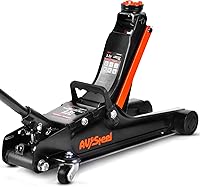
What Is a Low Profile Floor Jack?
A low profile floor jack is a wheeled hydraulic jack with a low starting saddle height for vehicles with limited ground clearance. Choose one that fits the path to your approved lifting point, supports the intended load, and rises high enough for the job.
On this page (10 sections)
- What is a low profile floor jack?
- What does minimum height tell you?
- How do minimum and maximum height work together?
- Does a lower jack always fit a low car?
- What else should you check before choosing one?
- How should you set up and care for the jack?
- What mistakes should you avoid when lifting?
- Is a floor jack safe to work under?
- Can ramps work instead of a low profile jack?
- What is a low profile floor jack best for?
A low profile floor jack is a wheeled hydraulic jack with a low starting saddle height, designed to slide beneath vehicles with limited ground clearance. If you're asking what is a low profile floor jack, the key difference is where it starts lifting.
A low saddle helps with access, but capacity, upward reach, and room beneath the car decide whether it's the right tool. Measure first, then choose around the job.
What is a low profile floor jack?
A low profile floor jack uses a low saddle and front section to reach lifting points that a taller jack may struggle to access. Pumping the handle raises the saddle through a hydraulic lifting arm.
“Low profile” describes clearance, not lifting strength. It doesn't mean the jack can lift every low car, and it doesn't promise enough reach for an SUV.
There isn't one minimum height shared by all low profile models. Compare the actual lifting range instead of choosing by the name alone.
What does minimum height tell you?
Minimum height tells you how much space the lowered saddle needs beneath the approved lifting point. You also need a clear path for the jack's frame and wheels.
The lowest bumper edge isn't the measurement that decides saddle fit. A central lifting point can sit farther under the car, where a rising jack frame may meet a splash shield or body panel.
Don't plan around an exact, rubbing fit. Leave room to position the saddle without pushing against parts that aren't meant to carry the vehicle's weight.
For a broader capacity and height check, see what size floor jack you need.
How to measure clearance for a low profile floor jack
Measure from a hard, level surface to the vehicle's approved lifting point. Use the vehicle manual to locate that point, and don't crawl under an unsupported car to take the measurement.
Check the route from the car's edge to that point as well. A low nose is only useful if the rest of the jack can follow it far enough underneath.
Measure the vehicle in the condition you'll work on it. Suspension settings, cargo, and a deflated tire can reduce the available gap.
How do minimum and maximum height work together?
Minimum height controls entry; maximum height controls upward reach. A jack must fit underneath and raise the vehicle enough to complete the task safely.
Wheel removal often needs more lift than the first movement of the body suggests. The suspension can extend before the tire leaves the ground, so don't judge the required reach from tire clearance alone.
For work on stands, the jack also needs enough reach to transfer the vehicle onto suitable stands at approved support points. Check this before choosing a short lifting range.
AV Steel: for garage work that needs more upward reach
The AV Steel has a 3-ton capacity and a lifting range of 3-1/8 to 19-7/8 in. Its dual-piston pump makes it a useful choice for a home garage where both low entry and taller lift reach matter.
Choose it if those measurements suit your lifting points and support equipment. Skip it if your measured clearance is too tight for its starting height; extra capacity won't solve an access problem.
BIG RED: for lighter equipment and lower lift needs
The BIG RED has a 2.5-ton capacity, a roughly 3.3 to 15 in lifting range, and a weight of 27.7 lb. It suits buyers who need to move the jack between storage and a work area, provided that range covers the job.
Its single-piston pump is a simpler option than the dual-piston pumps on the other models here. Skip it when your vehicle needs more upward travel for wheel removal or stand placement.
Does a lower jack always fit a low car?
No, saddle height alone doesn't guarantee access. Frame shape, reach to the lifting point, and space to move the handle can rule out a jack that appears low enough.
A jack must also roll as its lifting arm moves through an arc. Keep its wheels free to move on a suitable surface rather than wedging the frame into a tight spot.
SATA: for a fixed garage after a clearance check
The SATA has a 3-ton capacity, steel construction, a dual-piston pump, and a weight of 70 lb. It suits a garage where it can stay on the floor, rather than a buyer who needs to carry it often.
SATA gives conflicting minimum-height figures, so confirm the lowered saddle height with SATA before buying for tight clearance. Skip this choice if your decision depends on a precise entry height you can't confirm.
LARBANKE: for low cars in a permanent work area
The LARBANKE combines a 2.87 to 19.69 in lifting range with a 3-ton capacity and dual-piston pump. Its rubber saddle, foam handle bumpers, and removable handle are useful features for positioning and storage.
Choose it when the lower entry height makes a meaningful difference for your car. At 70 lb, it's a poor match for frequent carrying, and its rubber saddle still needs to suit the approved contact point.
What else should you check before choosing one?
Choose around load capacity, saddle contact, and working space, after checking the lifting range. None of these can compensate for a failure elsewhere.
Don't choose capacity by simply dividing the vehicle's weight by 4. Load distribution changes with the lifting point, so follow the vehicle and jack instructions for the intended lift.
Check whether the vehicle requires a specific saddle adapter. An adapter can change entry height and contact shape, so include it in your clearance check and use only an approved combination.
Leave enough room beside the vehicle to steer the jack and move its handle. A jack that fits under the sill may still be awkward to operate in a narrow garage.
The guide to how a floor jack works explains the basic lifting parts and operation. For options selected around low-clearance vehicles, see the best low profile floor jacks.
How should you set up and care for the jack?
Inspect the jack and follow its setup instructions before lifting. Look for hydraulic leaks, damage, loose parts, and wheels that don't move freely.
Assemble the handle as directed and check the lowering control without a load. If the instructions call for bleeding before first use, follow that model's procedure.
A spongy pump or failure to reach full height can require attention before use. The guide to how to bleed a floor jack explains air removal, but bleeding won't repair damaged parts or a leak.
Keep the wheels and moving joints clean, and lubricate only where the instructions direct. Store the jack lowered in a dry place and use the specified hydraulic fluid for any permitted service.
What mistakes should you avoid when lifting?
Use approved lifting points, stable ground, and controlled movements. Never substitute a convenient body panel for a lifting point or use loose blocks to gain height.
Set the parking brake and chock wheels as directed by the vehicle and equipment instructions. Avoid soft ground, slopes, and surfaces where the jack's wheels can sink or catch.
Stop if the saddle shifts, the vehicle moves unexpectedly, or the jack leaks or lowers on its own. Overload protection doesn't make an unsuitable lift safe.
Practice the release control without a load before raising the vehicle. During lowering, keep people and tools clear and use the controlled release described in the manual.
Is a floor jack safe to work under?
No, a hydraulic floor jack alone isn't safe support for working beneath a vehicle. A jack lifts; properly rated jack stands support the vehicle while you work.
Position stands at approved support points and transfer the load as the instructions direct. Confirm stable support before going underneath, keeping your body clear during lifting and lowering.
Never put any part of your body under a vehicle supported only by a jack. See how many jack stands you need and compare jack stands for cars when planning support equipment.
Can ramps work instead of a low profile jack?
Ramps can suit jobs that keep the wheels installed, such as some underbody maintenance. They don't provide the wheel-free access needed for tire, brake, or suspension work.
A low bumper may touch a ramp before the tire starts climbing. Ramp capacity, tire width, and approach angle all need to suit the vehicle.
Read what car ramps fit a low car if you're comparing ramp options. Follow the ramp instructions and don't combine lifting equipment in ways its instructions don't allow.
What is a low profile floor jack best for?
A low profile floor jack is best for a vehicle whose approved lifting point is hard to reach with a taller jack. Buy the model that clears the entire access path and provides the capacity and upward reach your task needs.
Choose AV Steel for its taller lift range when its entry height fits, or LARBANKE when lower entry is the deciding factor. Choose BIG RED for easier carrying and jobs within its shorter range; consider SATA once its minimum height is confirmed.
If you're keeping the wheels installed, compare ramps for low cars before committing to a jack and stands. The right choice follows the job and the vehicle's approved lifting method.
Frequently asked questions
What makes a floor jack low profile?
A low profile floor jack has a low starting saddle height that helps it fit beneath low-clearance vehicles. There isn't one starting height shared by every model, so compare actual measurements rather than the label alone; the jack body must also clear the path to the approved lifting point.
Is a low profile floor jack better for every car?
No, a low profile floor jack is most useful when clearance limits your choice. A higher-clearance car may gain little from a lower saddle, while maximum lift height and easy positioning may matter more; choose around your vehicle's approved lifting points, the required capacity, and the work you plan to do.
Can I use a low profile floor jack on an SUV?
Yes, if its rated capacity, saddle contact, and lifting range suit your SUV and the intended lift. An SUV may need more upward travel before a wheel clears the ground; check the vehicle manual and jack instructions rather than assuming that a low starting height also means enough lifting reach.
Does a low profile floor jack replace jack stands?
No, a floor jack lifts the vehicle but doesn't replace properly rated jack stands for work beneath it. Use approved support points and a hard, level surface, following the vehicle and equipment instructions; never place any part of your body beneath a vehicle supported only by a hydraulic jack.