Best Floor Jacks for a Home Garage
The best floor jack for a home garage is the BIG RED Trolley Floor Jack with Extra Saddle for higher-clearance vehicles. Choose a low-profile alternative for a low car, and match any jack to the vehicle's approved lifting points, required capacity and support plan.
On this page (9 sections)
- How do you choose the best floor jack for a home garage?
- Which floor jacks suit common home garage needs?
- How should you compare a floor jack's lift range?
- How do you set up a new floor jack before its first lift?
- How do you use a floor jack safely in a garage?
- Should you choose a steel or aluminum floor jack?
- How do you care for a floor jack between jobs?
- What mistakes cause trouble in a home garage?
- Which floor jack should you choose for your home garage?
The best floor jack for a home garage is the BIG RED Trolley Floor Jack with Extra Saddle for higher-clearance vehicles. Choose a low-profile alternative if you work on a low car, and put vehicle fit ahead of the overall ranking.
A useful jack must reach the approved lifting point, raise the vehicle far enough for your job and leave room for support stands. Pump speed and construction matter after those needs are met.
A floor jack lifts the vehicle; jack stands support it while you work. Never place any part of your body beneath a vehicle held only by a floor jack.
These four options cover higher-clearance vehicles and lower cars. To settle the capacity question first, read what size floor jack you need.
How do you choose the best floor jack for a home garage?
Choose by clearance, suitable capacity and usable lift range, then check reach and storage. A jack that misses any of those first three requirements is the wrong choice, even if it has a faster pump.
Start with your vehicle manual and the jobs you expect to do. Changing a wheel, placing an axle on stands and servicing several vehicles can require different lifting and support arrangements.
| Check | What to establish before buying |
|---|---|
| Capacity | The jack is suitable for the load and lift allowed by the vehicle instructions. |
| Minimum height | The saddle and body can pass beneath the vehicle. |
| Maximum height | The jack can raise the approved point enough for your task and stands. |
| Reach | The saddle can reach the lifting point without another part touching the vehicle. |
| Saddle fit | The contact surface or approved adapter matches the lifting point. |
| Garage space | There is room for the handle, wheels and stand placement. |
| Storage | You can park or move the jack without an awkward lift. |
Which floor jack height fits your home garage vehicles?
Measure at the approved lifting point, then check the route the jack must travel to reach it. Clearance below a bumper is useful only if the jack also clears everything farther underneath.
Allow space to position the saddle without scraping or forcing it into place. A minimum height that barely equals the available gap leaves little room for floor unevenness or changes in tire pressure.
A low saddle also does not guarantee a low frame along the jack's full length. A recessed lifting point may require both a low entry height and enough reach beneath the vehicle.
Read what a low-profile floor jack is if you need help separating entry clearance from lifting height. For a lowered car, both measurements deserve attention before you choose a model.
Consider flat-tire clearance if wheel changes are part of your plan. A jack that fits with an inflated tire may not fit after that corner drops.
What capacity should you choose?
Choose the capacity required for your vehicle and the lift you plan to make. Don't divide vehicle weight by four and assume that figure represents the load on the jack.
Vehicle weight is not always spread evenly, and lifting from a central point differs from lifting one corner. Follow the vehicle's capacity guidance and the jack's instructions rather than working from a shortcut.
All four models here carry a 3 ton designation. That shared label does not make them equally suitable for every car, SUV or truck because their access and lifting ranges differ.
If you maintain several vehicles, write down the requirements for each one. The lowest car may set the entry-height limit while a taller vehicle sets the lift-height requirement.
Which floor jacks suit common home garage needs?
Choose the BIG RED for higher-clearance vehicles, the Jack Boss for lower cars that fit its range, and the AV Steel for a lower entry target with more upward travel. Consider the Maxority only after confirming the measurements needed for your vehicle.
RegalRibbon compared clearance, lift range, construction and garage handling. The scores reflect those buying priorities; a lower-scoring jack can still be the better match for your car.
BIG RED Trolley Floor Jack with Extra Saddle
The BIG RED suits a garage centered on vehicles with enough clearance for a taller saddle. Its extra-long saddle neck makes it the most relevant starting point here for higher vehicles.
Score: 9/10. Best for higher-clearance vehicles.
This steel trolley jack has a single-piston quick-lift pump, 2 large steel casters and 2 swivel casters. It weighs 36 lb and includes a carrying handle, which matters if your storage spot requires lifting it across a doorway.
Its strongest reason to buy is the combination of extra saddle height and a relatively manageable carrying weight compared with the Jack Boss below. BIG RED backs it with a limited 1-year warranty.
Choose it when you can reach the approved point without fighting the vehicle's underbody clearance. A taller starting position is useful on a compatible vehicle, but it becomes a firm limit on a low car.
Skip it for a lowered vehicle unless you have measured the entire approach path and confirmed fit. Also check that the saddle neck works with your vehicle's lifting instructions rather than assuming a truck-friendly design fits every truck.
A higher maximum lift helps only when the jack can reach the right point and raise it through the needed travel. Plan stand placement before treating that extra height as a reason to buy.
Jack Boss 3 Ton Aluminum and Steel Racing Floor Jack
The Jack Boss suits a lower car when you want a rubber saddle and a dual-piston pump. Its combination of aluminum and steel does not make it a lightweight carrying choice.
Score: 8.8/10. Best for routine car maintenance.
The jack uses an aluminum body with a welded steel frame and includes a two-piece handle. Its maximum lifting height is 18-5/16 in, so compare the available travel with the height needed to place your stands.
At 58.5 lb, it makes more sense for a garage where it can remain on the floor and roll into position. Carrying it over steps or lifting it into a vehicle is a separate buying concern from how it moves on concrete.
The dual-piston pump is useful for repeated positioning during wheel and brake work. The rubber saddle adds a contact layer, but you still need the correct lifting point and any adapter required by the vehicle.
Skip it if carrying weight is your main concern, or if your intended lift needs more upward travel. A low starting height cannot compensate for an insufficient maximum height.
Jack Boss backs it with a limited 1-year warranty and states that it meets ANSI/ASME PASE safety standards. Those features support the buying case, while correct fit remains the first requirement.
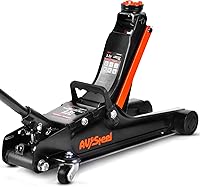
AV Steel 3 Ton Low Profile Floor Jack
The AV Steel is worth considering when a low car needs both a low entry point and substantial upward travel. Confirm its minimum saddle height before making a tight-clearance purchase.
Score: 8.3/10. Best for low-car garages.
This steel jack has a dual-piston pump, a rotating saddle and 2 rotating rear wheels. The pump design is useful when you need to bring the saddle up to contact without many handle strokes.
Its low entry target makes it a relevant option for a garage with a low car and jobs that require room for stands. Reach still needs checking, especially when the vehicle's central lifting point sits well behind the front bumper.
AV Steel states that the jack meets ANSI/ASME PASE safety standards. The brand also offers a 12-month warranty against design, material and workmanship defects.
Skip it if you cannot confirm clearance for your exact vehicle, particularly when the available gap is close to the minimum. Measure your parking space as well, since the handle and frame need room during positioning.
The rotating saddle may help align the contact surface, but it does not make an unsuitable lifting point acceptable. Confirm whether your vehicle requires a specific saddle shape or adapter before ordering accessories.
Maxority 3 Ton Low Profile Floor Jack
The Maxority suits buyers seeking a steel, low-profile jack with an extended-reach design. It needs a closer fit check because the exact minimum saddle height is not specified here.
Score: 8.2/10. Best for recessed lift points.
The jack has a dual-piston quick-lift pump and an overload valve. Maxority describes its extended reach as useful for low-clearance vehicles, but you need the actual reach measurement before relying on it for a recessed lifting point.
Ask for the minimum saddle height and the distance from the front of the jack to the saddle. Compare both with your vehicle, including any underbody panel or low trim along the approach path.
Skip it when you need a purchase based on confirmed low-clearance dimensions and cannot obtain those measurements. A low-profile description alone is too broad for a car with very little room underneath.
Maxority backs the jack with a 90-day warranty, shorter than the coverage named for the other options here. It also comes in a random color, which matters if you want a specific finish.
Its overload valve is a protective feature, not a way to judge whether a load is acceptable. Select capacity before lifting and stop if the jack does not operate as its instructions describe.
How should you compare a floor jack's lift range?
Compare entry height and maximum height together, then check usable travel at your vehicle's lifting point. Maximum saddle height is not the amount of open space you will gain beneath the car.
| Model | Capacity designation | Minimum saddle height | Maximum lift height |
|---|---|---|---|
| BIG RED Trolley Floor Jack with Extra Saddle | 3 ton | 5-7/8 in | 20-7/8 in |
| Jack Boss 3 Ton Aluminum and Steel Racing Floor Jack | 3 ton | 3-15/16 in | 18-5/16 in |
| AV Steel 3 Ton Low Profile Floor Jack | 3 ton | Advertised as 3-1/8 in; confirm before buying | 19-7/8 in |
| Maxority 3 Ton Low Profile Floor Jack | 3 ton | Confirm before buying | 19.9 in |
Some saddle travel is used simply to reach the vehicle. Suspension movement can also use part of the lift before a tire leaves the ground, depending on the approved lifting point.
For stand-supported work, you need enough height to position the stands and lower the vehicle onto them correctly. Choose stand settings allowed by their instructions rather than planning around the tallest possible position.
For especially low vehicles, compare our best low-profile floor jacks guide. For more choices within this capacity class, see the best 3 ton floor jacks.
Why do saddle shape and reach matter?
The saddle must contact the correct load-bearing point without pressing on nearby trim or panels. A jack that fits beneath the car can still be unsuitable if its contact surface does not match that point.
Some vehicles use reinforced pinch welds, while others have designated pads or central points. Follow the vehicle instructions for adapters rather than adding a generic puck and assuming it solves the fit.
Do not use loose wood, stacked pads or improvised extensions to gain height. Use only accessories approved for the jack and vehicle, within their stated limits.
Reach also affects stand placement. Before buying, establish where the jack goes and where the stands go so the two do not compete for the same space.
How do you set up a new floor jack before its first lift?
Read the jack manual, assemble it as directed and check its unloaded operation before lifting a vehicle. Do not assume it is ready straight from the box.
Inspect the frame, saddle, wheels, handle connection and hydraulic area for damage or leaks. If a part is missing, bent or loose, resolve that before putting a load on the jack.
Fit the handle and secure any fasteners exactly as instructed. Learn how the release control works while the saddle is unloaded so you understand its direction and movement.
Follow any model-specific preparation steps, including air purging or hydraulic-fluid checks when required. Do not remove plugs or add fluid based on instructions for a different jack.
Raise and lower the saddle without a load and check for smooth movement. If operation is irregular, stop and follow the troubleshooting guidance rather than using a vehicle to see whether the problem disappears.
Finally, choose a storage spot on the garage floor where the jack will not become a trip hazard. Keep the instructions somewhere you can reach them when maintenance or troubleshooting is needed.
How do you use a floor jack safely in a garage?
Use a hard, level surface, approved lifting points and correctly rated support equipment. Never place any part of your body beneath a vehicle supported only by the jack.
The vehicle, jack and stand instructions control the exact procedure. If they conflict with your planned setup, change the setup before lifting.
Prepare the vehicle and work area
Clear tools, cords and debris from the jack's route. Its wheels need room to move as the lifting arm changes position.
Set the transmission and parking brake as the vehicle instructions require, and chock the wheels that remain on the ground. Keep passengers out and other people clear of the work area.
Avoid sloped driveways, gravel, soil and surfaces that can deform under concentrated loads. A board beneath a jack does not turn an unsuitable surface into an approved lifting area.
Raise the vehicle and place the stands
Center the saddle on the approved point and raise it slowly until contact is secure. Stop if the saddle shifts, the jack binds or the vehicle moves unexpectedly.
Continue only to the height needed for the planned support arrangement. Position the stands at approved support points without putting your body beneath the unsupported vehicle.
Lower the vehicle onto the stands gradually and confirm secure seating as directed by the stand and vehicle manuals. Begin work only after the vehicle is properly supported.
Our guide to how many jack stands you need helps you plan the arrangement. If you still need support equipment, compare jack stands for cars.
Lower the vehicle with control
Before lowering, clear people and tools from beneath the vehicle and confirm that removed parts are back in place as required. Use the jack to unload the stands, then remove them without reaching beneath an unsupported vehicle.
Lower slowly using the release control as directed. Do not open it farther because the vehicle seems to be descending too slowly; stop and check the instructions if operation is abnormal.
Should you choose a steel or aluminum floor jack?
Choose by complete weight and garage handling, not material alone. Frame size, lifting range and construction all affect how practical a jack is to move.
Rolling across a smooth floor is different from carrying across a threshold. If you must lift the jack regularly, compare its weight with what you can handle comfortably and use its designated carrying points.
A garage-floor storage spot makes carrying weight less important. A tight shed or raised storage shelf makes that same weight a frequent burden.
Handle space matters too, particularly beside a wall or another parked car. Leave enough room for the full operating movement instead of checking only whether the stored jack fits.
For a closer look at that choice, read aluminum versus steel floor jacks. Use the comparison to plan movement and storage, then return to vehicle fit.
How do you care for a floor jack between jobs?
Keep the jack clean, dry and inspected, and follow its maintenance schedule. Small leaks, damaged wheels and irregular operation are reasons to stop using it until the fault is resolved.
Wipe away dirt after use so debris does not collect around moving parts. Store the saddle in the lowered position specified by the manual, away from standing water and unnecessary exposure to moisture.
Inspect before every lift, even if the jack worked normally the previous time. Look for fluid beneath it, damaged contact surfaces, loose hardware and wheels that no longer turn freely.
Lubricate only the points and with the products named in the instructions. Keep lubricants off contact surfaces where secure grip is needed.
Use the specified hydraulic jack fluid when service is required. Our guide to floor jack oil explains the fluid choice and why substitutes can cause problems.
If the saddle feels spongy, rises unevenly or will not reach its normal travel, follow the manual's fault checks. Air in the system is one possible cause, but bleeding is not a repair for damaged parts or a leaking hydraulic system.
Do not adjust an overload valve to make a jack lift more. Capacity limits remain the same after maintenance.
What mistakes cause trouble in a home garage?
The biggest buying mistake is choosing by capacity alone. The biggest use mistake is starting a lift without a workable plan for supporting and lowering the vehicle.
Buying for the vehicle name instead of its measurements
“Fits SUVs” or “low profile” describes a broad group, not your exact vehicle. Ride height, lift-point location and underbody shape determine whether the jack can reach safely.
Check each vehicle separately if the garage serves more than one. A jack chosen around a truck may never reach beneath the second car.
Confusing faster pumping with easier placement
A quick-lift pump reduces handle strokes, but it does not solve poor access. A correctly positioned saddle and room for the jack to roll matter more than speed.
If the handle cannot move freely beside the vehicle, your garage layout needs attention. Measure the working space before deciding where to park or store equipment.
Planning around maximum lift
Raising a vehicle higher than the task requires adds no useful benefit. Plan the minimum working height that allows correct stand placement and access.
Do not add improvised saddle extensions because a jack runs out of travel. Choose equipment with the required range from the start.
Lifting before finding separate support points
A convenient jack point may leave no room for a stand beside it. Work out the approved lifting and support sequence while the vehicle is still on the ground.
If the manual does not make the arrangement clear, obtain vehicle-specific guidance before proceeding. Guessing at a nearby frame member or body seam can damage the vehicle or create unstable support.
Which floor jack should you choose for your home garage?
The best floor jack for your home garage is the one that matches your hardest fit requirement and your normal work. Use these rules to make the final choice.
- Choose BIG RED for higher-clearance vehicles when its saddle arrangement and upward travel suit the approved lifting points.
- Choose Jack Boss for routine work on lower cars when its range fits and the jack can mostly remain on the garage floor.
- Choose AV Steel when low entry and greater upward travel are priorities, after confirming the minimum saddle height.
- Choose Maxority for its extended-reach design only after confirming both entry height and reach for the vehicle.
Before ordering, write down the approved lift point, approach clearance, required capacity and stand arrangement. Those four checks are more useful than choosing by score alone.
If no model meets the full plan, keep looking rather than solving a fit problem with an improvised adapter. Browse our floor jack guide for a broader comparison.
Frequently asked questions
What is the best floor jack for a home garage?
The BIG RED Trolley Floor Jack with Extra Saddle is our first choice for higher-clearance vehicles that fit its operating range. For a lower car, choose a low-profile model that reaches the approved lift point; clearance, suitable capacity and room to position support stands matter more than the overall ranking.
Is a 3 ton floor jack enough for a car?
A 3 ton floor jack can suit many cars when the vehicle and jack instructions allow the planned lift. Don't estimate the load by dividing vehicle weight evenly between wheels; weight distribution and the chosen lifting point affect the load, so follow the required capacity guidance for your vehicle.
Do I need a low profile floor jack?
You need a low-profile floor jack when a taller saddle or jack body cannot reach the approved lifting point. Measure both the clearance at that point and the path underneath the vehicle; leave room to position the jack without contact, and remember that a flat tire can reduce clearance further.
Can I work under a car supported by a floor jack?
Never work beneath a vehicle supported only by a floor jack. Lift at the vehicle's approved point, then lower the vehicle onto correctly rated stands at approved support points; use a hard, level surface, chock the wheels as instructed and confirm stable support before beginning work underneath.
How do I choose between a steel and aluminum floor jack?
Choose by the complete jack's weight, fit and storage needs rather than its material name. A jack with aluminum parts can still be heavier than a smaller steel model; compare the lift range, handle space and carrying needs, especially if you must move it over a threshold or store it on a shelf.