Low Profile vs Regular Floor Jack: Which to Buy? (November 2026)
Buy a low profile jack for a lowered car or low front splitter, and a regular jack for stock cars and taller vehicles. In this low profile vs regular floor jack comparison, the DNA Motoring low profile trolley wins overall for most garage lifting needs because it balances a 5.1 inch start height with a 13 inch top and a 2 ton rating.
On this page (6 sections)
Buy a low profile jack for a lowered car or low front splitter, and a regular jack for stock cars and taller vehicles. In this low profile vs regular floor jack comparison, the DNA Motoring low profile trolley wins overall for most garage lifting needs because it balances a 5.1 inch start height with a 13 inch top and a 2 ton rating.
The difference is mostly about the start height. A low profile jack starts low enough to slide under a low sill or bumper, while a regular jack starts taller and usually reaches higher.
The DNA Motoring is our best overall pick. The BIG RED is the regular jack we would choose for taller vehicles.
The Jack Boss and Maxority are low profile options for lower, heavier or harder-to-reach cars.
Low profile vs regular floor jack: which fits your car?
The low profile design wins for low cars and the regular design wins for high ones. Measure the gap between the ground and your car's jack point before you choose, because a jack that won't slide under can't lift anything.
The DNA Motoring starts at 5.1 inches and tops out at 13 inches. The BIG RED starts at 5-7/8 inches and reaches 20-7/8 inches.
That means the DNA fits under cars the BIG RED can't reach. In return, the BIG RED gives you almost 8 more inches of lift for high vehicles.
A regular jack on a low car is the classic mistake. The saddle hits the bumper or side skirt before it reaches the jack point, so you end up driving onto boards to make room.
A low profile jack on an SUV is less of a problem. It works, but its low start is wasted and its shorter top may not lift the wheels as high as you want.
What counts as a low car?
Cars with lowered suspension, aftermarket body kits and low front splitters are the usual cases. Sports cars and modified daily drivers often sit close to the ground at the jack points.
If your sill height is around 5 inches or less, choose a low profile jack. If it's around 6 inches or more, a regular jack will fit without trouble.
When does a regular jack make more sense?
Stock sedans, crossovers, vans and SUVs all sit high enough for a regular jack. The BIG RED's extra height also helps when you need to lift a wheel clear for tire rotation or brake work.
Regular jacks also tend to cost less for the same capacity. If your car isn't low, the low start height is a feature you pay for and never use.
Lift range and capacity: how the four jacks compare
Capacity and lift range are the two numbers that decide the job. Read both before you buy, because a tall top doesn't help a heavy car and a big rating doesn't help a low one.
The DNA Motoring is rated at 2 tons (4,000 lb) with a 5.1 to 13 inch range. The BIG RED is rated at 3 tons (6,000 lb) and reaches 20-7/8 inches.
The Jack Boss is also 3 tons, but its start height of 3-15/16 inches makes it the lowest starter here. The Maxority is rated at 6600 lbs with a 19.9 inch top.
| Product | Best for | Capacity | Lift range | Body | Our score |
|---|---|---|---|---|---|
| DNA Motoring TOOLS-00234 Low Profile Hydraulic Trolley | overall | 2 tons | 5.1 to 13 in | Alloy steel | 9.7 |
| BIG RED Trolley Floor Jack with Extra Saddle | taller vehicles | 3 tons (6,000 lbs) | 5.88 to 20.88 in | Steel | 9.0 |
| Jack Boss 3 Ton Aluminum and Steel Racing Floor Jack | low sports cars | 3 tons | 3.94 to 18.31 in | Aluminum and steel | 8.8 |
| Maxority 3 Ton Low Profile Floor Jack | lowered modified cars | 6600 lbs | Alloy steel | 8.2 |
Which jack has the best lift range?
The BIG RED has the widest overall lift range, while the Jack Boss has the lowest start of the four. The DNA Motoring has the lowest start of the two main picks.
For a single garage with mixed vehicles, the Jack Boss's low start covers the lowest cars. For a garage with one low car and light loads, the DNA does the job for less bulk.
How much capacity do you actually need?
Count the weight on the corner you lift, not the whole car. A typical sedan puts well under a ton on each corner, so a 2 ton jack leaves room to spare.
Heavier vans, trucks and loaded SUVs benefit from a 3 ton rating. The extra capacity is margin, not a promise that you can lift the whole vehicle.
Low profile vs regular floor jack in a home garage
A home garage usually holds one car and one set of tools. If that car is low, choose low profile.
If it's a family SUV or a stock sedan, the regular jack's height is more useful.
If two cars share the garage, one low and one high, the Jack Boss covers both ends. The Maxority's long reach helps when jack points sit behind a low bumper.
The four jacks we compared
DNA Motoring TOOLS-00234 Low Profile Hydraulic Trolley: Best overall

- 2 ton (4,000 lb) capacity
- 5.1 to 13 inch lift range
- Steel body with swivel casters
- Overload safety release valve
A low start height for low cars, a 13 inch top for routine service and a 2 ton rating for most passenger cars. This is the jack we would hand most garage owners first.
Pros
- Starts at 5.1 inches for low clearances
- Reaches 13 inches for wheel and brake work
- Overload valve triggers on too much load
- Swivel casters help you position it
Cons
- 2 ton rating leaves less margin on heavier trucks
- Not for holding a car up on its own
The DNA Motoring TOOLS-00234 is the low profile jack we would give most people. Its 5.1 inch start clears low sills, and its 13 inch top covers wheel swaps, brake work and fluid changes on a typical car.
The 2 ton (4,000 lb) rating suits passenger cars and light loads. A steel body and swivel casters keep it steady and easy to roll into place, and a large saddle helps spread the load.
A built-in safety release valve triggers on overload. That's a useful backup, but it doesn't replace correct lifting habits or rated stands.
The jack is for lifting only. Lower the car onto stands before you go underneath.
For a full field of low profile options, see our roundup of the best low profile floor jacks.
BIG RED Trolley Floor Jack with Extra Saddle
BIG RED Trolley Floor Jack with Extra Saddle: Best for taller vehicles
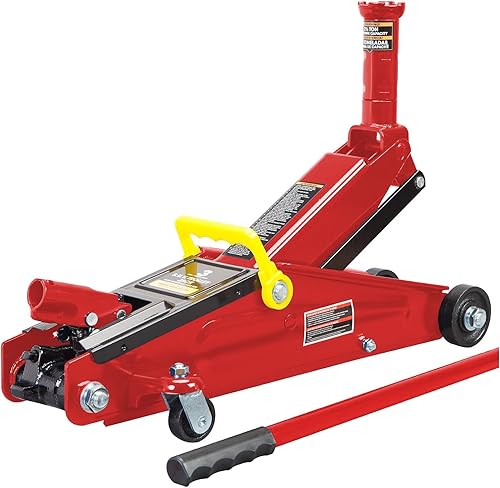
- 3 ton (6,000 lb) capacity
- 5-7/8 to 20-7/8 inch lift range
- Extra long saddle neck
- Single piston quick lift pump
The height to reach SUVs, vans and lifted trucks, plus a 3 ton rating for heavier loads. Pick this when your vehicles sit high rather than low.
Pros
- 20.88 inch top suits SUVs and vans
- 3 ton rating covers heavier vehicles
- Quick lift pump raises fast
- Extra long saddle neck saves time on high vehicles
Cons
- 5-7/8 inch start is too tall for low cars
- 36 pounds to lift and carry
The BIG RED T83006 is the regular jack for high vehicles. Its 20-7/8 inch top reaches SUV, van and lifted truck jack points without stacking blocks, and the extra long saddle neck saves time on tall vehicles.
The 3 ton (6,000 lb) rating gives more margin on heavier loads. A single piston quick lift pump raises the saddle fast, and the safety bypass system guards against overloading.
Two large steel casters and two 360 degree swivel casters make it easy to steer. The 24.5 inch handle gives you reach and leverage, though the 36 pound body takes some lifting to move.
Its 5-7/8 inch start is the trade-off. It won't slide under a very low car, so keep this one for taller vehicles.
If your car sits low, the Jack Boss is the better fit.
Jack Boss 3 Ton Aluminum and Steel Racing Floor Jack
Jack Boss 3 Ton Aluminum and Steel Racing Floor Jack: Best for low sports cars

- 3 ton (6,600 lb) capacity
- 3-15/16 to 18-5/16 inch lift range
- Aluminum body and steel frame
- Dual piston quick lift pump
A 3-15/16 inch start slips under the lowest sports cars, while the 3 ton rating still covers heavier sedans and SUVs. The best pick for a slammed daily driver.
Pros
- 3-15/16 inch start clears very low cars
- 3 ton rating for heavier loads
- Dual piston pump reduces pumps
- Rubber saddle protects lifting points
Cons
- Steel and aluminum body is not the lightest option
- Racing look is more than some garages need
The Jack Boss AS830011L is the pick for low sports cars and heavier loads together. Its 3-15/16 inch start is the lowest here, so it slips under very low cars without ramps or boards.
It still carries a 3 ton (6,600 lb) rating and reaches 18-5/16 inches. The dual piston quick lift pump cuts the number of strokes to reach the saddle, and the rubber saddle protects lifting points.
An aluminum body on a welded steel frame keeps weight down without giving up strength. Jack Boss says the jack is factory tested to 1.5 times its rated load and meets ANSI/ASME PASE standards.
The catch is the bulk. The aluminum and steel build is not the lightest jack here, and the racing look is more than a plain garage needs.
If low height and high capacity both matter, this is the one to beat.
Maxority 3 Ton Low Profile Floor Jack
Maxority 3 Ton Low Profile Floor Jack: Best for lowered modified cars

- 3 ton (6,600 lb) capacity
- Long reach for low clearance
- RAPID PUMP hydraulic system
- Built-in safety valve
An extended reach low profile jack for aftermarket-modified cars and lowered vehicles with awkward jack points. A good pick when access matters more than the start height.
Pros
- Long reach gets to recessed jack points
- RAPID PUMP cuts pump strokes
- 19.9 inch top for service height
- Safety valve guards against overload
Cons
- 90 day warranty is shorter than some rivals
The Maxority MAX1901-20MIX is built for lowered and modified cars where the jack point is hard to reach. Its long reach gets to points set back behind a low bumper, which a short saddle can't do.
It carries a 6600 lb rating and reaches 19.9 inches. RAPID PUMP technology means fewer strokes to lift, and a built-in safety valve guards against overloading.
The stable saddle helps hold the car in place while raised. High-strength steel construction suits frequent use in a home or workshop garage.
The trade-off is the shorter 90 day warranty, which is less coverage than the rivals here. Measure your clearance before you order, since the low start height matters more than anything on a lowered car.
Head-to-head: the points that decide the choice
Start height is the first split, capacity the second, and reach the third. These are the points that push a buyer toward one jack over another.
DNA Motoring vs BIG RED: low car or high car?
This is the core low profile vs regular decision. The DNA Motoring starts at 5.1 inches, while the BIG RED starts at 5-7/8 inches, so the DNA fits under anything the BIG RED can't reach.
The BIG RED wins on top height at 20-7/8 inches and on capacity at 3 tons, against 13 inches and 2 tons for the DNA. For a low car, the DNA wins.
For an SUV or van, the BIG RED does.
Jack Boss vs DNA Motoring: which low profile jack?
The Jack Boss starts lower at 3-15/16 inches against 5.1 inches, so it clears the very lowest cars the DNA can't. It also carries a 3 ton rating against 2 tons.
The DNA wins on simplicity and price tier. If your car sits around 5 inches and is a normal passenger car, the DNA is enough.
If it's slammed or heavy, the Jack Boss is the better buy.
Maxority vs BIG RED: reach or height?
The Maxority's long reach gets to recessed jack points, while the BIG RED's long saddle neck gets you height. One solves access, the other solves lift.
If your car's jack point sits far back behind a low bumper, the Maxority reaches it. If your car sits high and needs a tall lift, the BIG RED is the one.
Neither is the best overall pick here.
Which is easier to move and store?
The BIG RED weighs 36 pounds and has a carrying handle. The Jack Boss weighs 58.5 pounds, so it's the heavier jack to move around.
The DNA's swivel casters make it easy to roll, and its smaller size suits a packed garage. If you move the jack often or store it on a shelf, weight matters as much as lift.
Who should buy which jack?
Most home garages should buy the DNA Motoring low profile trolley, and taller-vehicle owners should buy the BIG RED. The other two suit more specific cars.
- DNA Motoring TOOLS-00234: the best overall for a normal car in a home garage. It starts low, reaches a useful height and rolls easily.
- BIG RED T83006: the best regular jack for SUVs, vans and lifted trucks. Its 20-7/8 inch top and 3 ton rating suit heavy, high vehicles.
- Jack Boss AS830011L: the best for low sports cars and heavier loads. The 3-15/16 inch start and 3 ton rating cover slammed cars that still weigh a lot.
- Maxority MAX1901-20MIX: the best for lowered and modified cars with hard-to-reach jack points. The long reach does the work here.
If you're unsure which type you need at all, our explainer on what is a low profile floor jack covers how the design works. For help matching a jack to your car and budget, see which floor jack should I buy.
If you're also weighing a bottle jack against a trolley jack, our bottle jack vs floor jack comparison covers that choice.
Verdict: low profile or regular for your garage?
The DNA Motoring low profile trolley wins overall for most readers. Its 5.1 inch start handles low cars and its 13 inch top covers routine service, all with a 2 ton rating and an overload valve.
Pick the BIG RED if your vehicles sit high. Pick the Jack Boss if you drive a very low or heavy car.
Pick the Maxority if reach to a recessed jack point is the problem.
Whatever you choose, a floor jack only lifts. Lower the car onto rated jack stands before you work underneath, and never leave a car resting on the jack alone.
Frequently asked questions
What is the difference between a low profile and a regular floor jack?
A low profile jack starts lower, often under 4 inches, so it slides under low cars and split bumpers. A regular jack starts taller and usually reaches higher, which suits stock cars, SUVs and vans.
Can a regular floor jack fit under a lowered car?
Often no. The DNA Motoring low profile jack starts at 5.1 inches and the BIG RED regular jack at 5-7/8 inches, so a car sitting under about 5 inches needs the lower jack.
Measure your sill height before you buy.
Do I need a low profile floor jack for an SUV?
Usually not. SUVs sit high and benefit from a longer lift range instead, like the BIG RED's 20-7/8 inch top.
A low profile jack can still work, but its lower start is wasted on a high vehicle.
How much capacity do I need in a floor jack?
Pick a jack rated above the load you lift. A 2 ton jack covers most cars and small SUVs, while a 3 ton jack gives more margin for vans, trucks and heavier vehicles.
Jack stands still hold the car.
Can I leave a car on a floor jack?
No. Every floor jack here is for lifting only.
Lower the car onto rated jack stands before you work underneath, and never use the jack as a stand.
Which floor jack is best for a home garage?
The DNA Motoring low profile trolley is the best overall for most home garages. Its 5.1 inch start handles low cars and its 13 inch top covers routine brake and wheel jobs.