Which Floor Jack Should I Buy?
Choose which floor jack to buy by checking vehicle fit first: match capacity, entry height, maximum saddle height and approved lift points, then compare carrying weight and pump style.
On this page (9 sections)
- Which floor jack should I buy for my vehicle?
- What should I check before buying a floor jack?
- Which floor jack is the best fit for each buyer?
- Should you buy a steel or aluminum floor jack?
- Which pump style should you choose?
- How should you set up a floor jack for the first lift?
- How do you care for a floor jack?
- What mistakes should you avoid when choosing a floor jack?
- Which floor jack should I buy for my next job?
Choose which floor jack to buy by matching it to your vehicle's approved lift points, weight and clearance. Then compare how high it lifts, how easily you can move it and whether a faster pump will help with your usual jobs.
For a low passenger car, start with the AV Steel 2.5 Ton model. For a compatible standard SUV or pickup, consider the AV Steel 3 Ton model; the Yellow Jacket and SATA offer dual-piston pumps for buyers who want faster lifting.
Which floor jack should I buy for my vehicle?
Buy the jack that passes every fit check for your vehicle and job, then choose the features you prefer. These four models cover different needs, from low passenger cars to compatible SUVs and light trucks.
Use the table to rule out unsuitable models before weighing convenience features. Minimum and maximum heights refer to the saddle, while jack weight tells you what you'll need to move or carry.
| Model | Rated capacity | Saddle height range | Jack weight | Pump |
|---|---|---|---|---|
| AV Steel Low Profile | 2.5 ton | 3.4–14.6 in | 30 lb | Single piston |
| AV Steel Single Piston | 3 ton | 5.5–18.5 in | About 64 lb | Single piston |
| Yellow Jacket Aluminum and Steel | 3 ton | 3.94–18-5/16 in | 58.6 lb | Dual piston |
| SATA Aluminum | 3 ton | 3.75–19-1/8 in | Confirm before buying if carrying matters | Dual piston |
For more models and use cases, see our best floor jacks guide. The home garage floor jack guide also helps you compare options for routine maintenance.
What should I check before buying a floor jack?
Check capacity, entry clearance, maximum lift, reach and saddle fit before considering material or pump speed. A jack must meet all these needs to work with your vehicle.
Write down your vehicle's model, year and any suspension changes before comparing equipment. Use its manual to find approved lifting and support points, which may be separate locations.
Which floor jack capacity should you buy?
Choose a capacity that meets the vehicle and jack instructions for the planned lift. Don't divide the vehicle's weight by 4 and assume that figure gives the load on the jack.
A jack raising one end carries a different load from one lifting at a corner, and vehicle weight is not evenly shared. If the instructions don't make suitability clear, ask the vehicle manufacturer or a qualified service professional before buying.
Also check explicit vehicle limits. The smaller AV Steel is for passenger cars, while the larger AV Steel excludes lifted vehicles, heavy-duty trucks and RVs despite its higher capacity.
Our guide to what size floor jack you need explains how capacity and height work together. Buying extra capacity does not solve a jack that cannot fit or reach.
How low does a floor jack need to go?
The lowered saddle and any required adapter must fit beneath the approved lift point with room to position them correctly. Measure with the vehicle parked on the same kind of hard, level surface you'll use for lifting.
Check the whole approach path, not just the gap at the lift point. A bumper, side skirt or undertray can block the jack before its saddle reaches the right spot.
Low entry height also does not guarantee a low chassis along the jack's full length. This matters when the approved point sits well inward from the body edge.
If roadside wheel changes are part of your plan, consider that a flat tire can leave less clearance than an inflated one. Our guide to what a low profile floor jack is covers the fit questions behind that label.
How high should a floor jack lift?
Choose enough maximum saddle height to raise the vehicle for the task and place the supports correctly. Maximum saddle height is not the distance the car will rise.
For example, a saddle starting at a lift point 6 in above the floor and ending at 15 in has moved that point 9 in. Suspension droop means the wheel may rise less than the body during that movement.
Check the working height of your jack stands as part of the same plan. You need room to position them at an approved setting and transfer the load as their instructions direct.
Never add loose wood, bricks or stacked pads to make a short jack reach higher. Use equipment and any adapters approved for the vehicle and jack.
Will the saddle and handle work in your space?
The saddle must seat correctly at the approved point, and the handle needs enough room for its pumping arc. A jack that fits under the car can still be awkward beside a wall or a packed garage shelf.
Check whether the vehicle needs a pinch-weld pad, jack-point puck or another specified adapter. A broad saddle is not permission to lift beneath a battery enclosure, floor panel or unapproved suspension part.
Plan stand placement at the same time. If the jack occupies the only approved support location, resolve the lifting sequence using the vehicle instructions before raising it.
Which floor jack is the best fit for each buyer?
Choose the model that solves your main fit or handling problem without creating another one. RegalRibbon's recommendations below focus on vehicle use, lift range, construction and pump features.
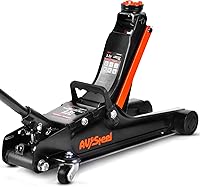
AV Steel 2.5 Ton Low Profile Floor Jack for low cars
Best for low passenger cars: buy this model for a compatible coupe, hatchback or sedan when low entry height and manageable carrying weight matter most. It is the lightest jack with a stated weight in this group.
Its main limit is maximum height. A car may have enough clearance for the jack but still need more upward travel to lift a wheel and reach a suitable stand position.
The steel construction, rotating rear wheels and rotating saddle suit positioning around a home garage. Its single-piston pump makes it a sensible choice when occasional maintenance matters more than pump speed.
Skip it for trucks, SUVs and lifted vehicles, which AV Steel excludes. Also skip it if your support setup needs more height, even when the car falls within the jack's capacity.
AV Steel 3 Ton Single Piston Floor Jack for standard larger vehicles
Best for standard family vehicles: choose this jack for compatible cars, minivans, SUVs and standard pickups when it will mostly roll around one garage. Its steel construction comes with a carrying weight that deserves attention before ordering.
The taller starting position makes low-car clearance the first thing to check. A household with an SUV and a low sedan should verify both vehicles rather than assume one jack covers the driveway.
AV Steel includes overload protection and a rotating saddle, and recommends a jack-point adapter for EVs. Use the vehicle's exact adapter guidance to protect the approved contact point.
Skip it for frequent carrying, lifted vehicles, heavy-duty trucks or RVs. Buyers doing several lifts in a session may also prefer one of the dual-piston options.
Yellow Jacket 3 Ton Aluminum and Steel Floor Jack for frequent lifting
Best for frequent garage jobs: choose the Yellow Jacket when you want a dual-piston pump, low entry and mixed aluminum-and-steel construction. It suits buyers who value fewer pumping strokes during repeated lifting tasks.
The rubber saddle and foam handle bumper help protect contact surfaces, while the side handle helps with positioning. Those features are useful around bodywork, but they do not replace a vehicle-specific adapter.
Its stated weight makes it a rolling garage tool for many buyers, even though it combines 2 materials. Check the route between your storage space and work area, especially if it includes steps.
Skip it if easy carrying is your priority or its entry height is too tall for your car. Confirm the capacity and full lift range for your particular truck or SUV instead of relying on broad vehicle labels.
SATA 3 Ton Aluminum Floor Jack for mixed vehicle heights
Best for mixed vehicle heights: consider the SATA for a compatible low sedan, SUV or light truck when you want low entry and the highest maximum saddle position in this group. Its dual-piston pump also suits repeated garage work.
The aluminum construction is worth considering if moving a heavy steel jack is a concern. Confirm its actual weight before buying for carrying, since material alone does not tell you the load you'll be lifting.
SATA includes an overload protection valve and a controlled-release system. Learn the release control before using the jack under load, and lower slowly according to its instructions.
Skip it if your vehicle needs still more height or a lower entry point. Don't choose it solely for a weight-saving claim when a firm carrying limit is part of your shopping requirements.
Should you buy a steel or aluminum floor jack?
Choose by actual weight, storage and movement needs, then consider material. A jack you roll across a garage floor presents a different handling problem from one you lift into a trunk.
The smaller steel AV Steel weighs less than the larger mixed-metal Yellow Jacket. That comparison shows why construction material cannot stand in for a carrying-weight check.
For a shared garage, think about who will move the jack and where it will live. A heavy model may work well beside the car but become a poor choice if every job starts with carrying it downstairs.
Measure storage height and handle space too. Our aluminum vs steel floor jacks guide goes deeper into the trade-offs.
Which pump style should you choose?
Choose dual pistons for faster lifting when you make repeated lifts, and accept a single-piston pump when occasional use makes speed less important. Both styles still need the right capacity, clearance and lift range.
Yellow Jacket and SATA describe their dual-piston systems as faster lifting designs. The benefit is convenience while raising the saddle, not permission to rush alignment or support placement.
A single-piston model can suit seasonal wheel changes or occasional maintenance. Buy the jack that fits correctly before paying attention to how quickly its saddle rises.
Lowering control deserves just as much care as pumping speed. Make small release movements and follow the instructions for the specific control mechanism.
How should you set up a floor jack for the first lift?
Read the jack manual, inspect the equipment and prepare the support positions before raising the vehicle. First-use assembly and hydraulic preparation can differ between models.
- Inspect the jack. Check for damage, fluid leaks, loose parts and wheels that bind; stop if anything appears unsafe.
- Complete assembly. Fit and secure the handle as directed, and follow any required first-use bleeding procedure.
- Prepare the vehicle. Park on a hard, level surface and follow its instructions for the transmission, parking brake and wheel chocks.
- Set out the stands. Confirm their capacity, height settings and approved support locations before starting.
- Align the saddle. Center it beneath the approved lift point with the correct adapter, if needed.
- Raise and support. Watch alignment as the saddle makes contact, then follow the prescribed sequence for placing stands and transferring the load.
Keep people clear while lifting or lowering, and never put any part of your body beneath a vehicle supported only by the jack. If the saddle shifts or the equipment behaves oddly, stop and lower safely.
Allow the jack to roll as required while its lifting arm changes position. Don't wedge its wheels or use it on gravel, where movement and support can become unreliable.
Use properly rated jack stands before working underneath. Read how many jack stands you need to plan the supports for your job.
How do you care for a floor jack?
Keep it clean, dry and inspected, and follow its manual for lubrication, fluid checks and storage. Remove a jack from service if it leaks, lowers unexpectedly or has damaged parts.
Wipe dirt from the wheels and exposed moving areas after use. Store the jack lowered as directed, away from standing water and corrosive chemicals.
Use only the hydraulic fluid specified for the jack. Our floor jack oil guide explains fluid choices and why unrelated automotive fluids are not substitutes.
If the jack feels spongy or fails to reach its normal travel, follow its troubleshooting instructions. Air may require bleeding, but repeated problems or visible leakage call for service rather than repeated pumping.
Do not adjust an overload valve to increase capacity. It is a protection feature, and the jack's rated limit remains the limit.
What mistakes should you avoid when choosing a floor jack?
Avoid choosing by capacity or the words “low profile” alone. Most buying errors come from overlooking a second measurement or the practical setup around the vehicle.
- Buying for only one vehicle. Check every car you expect to service, including any required adapters.
- Ignoring suspension changes. Lowering or lifting a vehicle can change clearance and height needs.
- Confusing saddle height with wheel clearance. Suspension movement affects how far the tire rises.
- Forgetting support placement. A jack must work with your stand locations and lifting sequence.
- Treating wheels as portability. Rolling across concrete and carrying up steps are different tasks.
- Using protection features as support. Overload valves and controlled release do not replace jack stands.
Avoid buying around a job you cannot set up safely at home. Limited space, an unsuitable surface or unclear lift points should be resolved before choosing equipment.
Which floor jack should I buy for my next job?
Decide which floor jack to buy by eliminating poor fits first, then choose the handling features you'll use. Take your clearance, lift-height and support measurements with you when comparing models.
Pick the AV Steel 2.5 Ton for a compatible low passenger car and occasional work when its shorter lift range is enough. Pick the AV Steel 3 Ton for compatible standard family vehicles when the jack can mostly stay on the garage floor.
Choose the Yellow Jacket for repeated garage lifting with a dual-piston pump and protective contact features. Choose the SATA when its wider height range suits your vehicles, and confirm its weight if carrying matters.
Before ordering, make one final check that the jack, adapter and stands work together at approved points. If capacity or height remains unclear, use our floor jack size guide to settle those measurements first.
Frequently asked questions
How do I know what size floor jack to buy?
Choose a floor jack whose capacity, entry height and maximum saddle height suit your vehicle and lifting task. Check approved lift points in the vehicle manual, including any adapter requirements, then compare those needs with the jack instructions; a larger capacity cannot make up for poor clearance or insufficient reach.
Is a 2.5 ton floor jack enough for a car?
A 2.5 ton floor jack can suit a passenger car if its capacity, lift range and saddle match the vehicle's requirements. The AV Steel 2.5 Ton Low Profile Floor Jack is intended for cars and sedans, with trucks and SUVs excluded; confirm the exact fit before buying.
Should I buy a low profile floor jack?
Buy a low profile floor jack when a taller saddle cannot reach your car's approved lift point without touching the body or undertray. Check the approach path as well as clearance at the point itself; any required adapter adds height, and maximum lift still needs to suit the job.
Can a floor jack hold a car while I work underneath?
No, never work underneath a vehicle supported only by a floor jack; transfer the load to correctly rated jack stands at approved support points, following all equipment instructions. Plan the jack and stand positions before lifting so you can place the supports without reaching beneath an unsupported vehicle.