7 Best Car Ramps (November 2026)
The best best car ramps for home maintenance include the MaxxHaul 50515 Car Ramps for everyday garage maintenance, the MaxxHaul 50947 Stackable Car Ramps for shared garage space, and the MaxxHaul 50709 Extendable Car Ramps for flexible underbody access.
On this page (10 sections)
- How we chose the best car ramps
- Car ramps compared
- The best car ramps for home maintenance
- How to choose car ramps that fit your vehicle
- How to set up car ramps before going underneath
- Common car ramp mistakes to avoid
- How to clean, inspect and store car ramps
- Car ramps or a floor jack: which works better?
- Can you use car ramps with jack stands?
- Which car ramps should you buy?
The MaxxHaul 50515 is our top choice among the best car ramps for routine home maintenance because it combines useful lift with tire traction and rubber base stops. Choose a different design when low-car clearance, storage or access beneath the approach sections matters more.
Ramps suit jobs where the wheels can stay on their platforms, such as many oil changes and visual inspections. They aren't the right support method for removing the wheels resting on them.
For a low front end, start with car ramps for low cars. The ramps and creepers guide covers related equipment for working beneath your vehicle.
Our picks at a glance
-
1
 Best for everyday garage maintenance
MaxxHaul 50515 Car Ramps, 6.25 Inch Lift
8.9/10 our score
See it on Amazon -
2

-
3
 Best for flexible underbody access
MaxxHaul 50709 Extendable Car Ramps
8.1/10 our score
See it on Amazon
- 4
 Check it
Tomioka Racing Super Slopes Car Service Ramps
Best for lowered car owners - 5
 Check it
Florety Heavy Duty RV Wheel Car Ramps
Best for RV maintenance planning - 6
 Check it
Black Widow 6.5 Inch Lift Car Service Ramps
Best for frequent underbody servicing - 7
 Check it
TOWKING 16000 lb Stackable Car Ramps
Best for taller vehicle maintenance
How we chose the best car ramps
Vehicle fit and a useful working position matter more than the largest capacity claim. We compared lift, approach, tire contact features, storage and whether the load limits are clear enough to guide a buying decision.
The scores favor ramps that suit common home maintenance without adding avoidable fit questions. Specialized designs remain useful when they solve a particular problem, such as making room for a jack beneath a lowered car.
A vehicle weight limit, an axle limit and a load limit for the pair describe different things. Conflicting figures lower our confidence in a recommendation because you need the correct limit before loading the ramps.
The MaxxHaul 50709 has conflicting capacity claims, so follow no more than 3,250 lb per ramp and 6,500 lb per matched pair. Tomioka, Florety and Black Widow also need load-limit confirmation for the exact model before use.
Car ramps compared
The 50515 is the general-purpose starting point, while the other choices solve storage, clearance or access problems. Use this table to narrow the field, then check the full ramp profile and instructions against your vehicle.
| Product | Best for | Lift height | Capacity | Material | Our score |
|---|---|---|---|---|---|
| MaxxHaul 50515 Car Ramps, 6.25 Inch Lift | everyday garage maintenance | 6.25 in | 3,250 lb per ramp; 6,500 lb per pair | Heavy-duty plastic | 8.9 |
| MaxxHaul 50947 Stackable Car Ramps | shared garage space | 6.7 in | 3,250 lb per ramp; 6,500 lb per pair | Polypropylene | 8.5 |
| MaxxHaul 50709 Extendable Car Ramps | flexible underbody access | 6.5 in maximum | 3,250 lb per ramp; 6,500 lb per matched pair | Polypropylene | 8.1 |
| Tomioka Racing Super Slopes Car Service Ramps | lowered car owners | About 2.56 in | 7.2 | ||
| Florety Heavy Duty RV Wheel Car Ramps | RV maintenance planning | 5.5 in | 20,000 lb claim; load basis needs confirmation | 7.1 | |
| Black Widow 6.5 Inch Lift Car Service Ramps | frequent underbody servicing | 6.5 in | 7.0 | ||
| TOWKING 16000 lb Stackable Car Ramps | taller vehicle maintenance | 7.3 in | 16,000 lb per pair | 6.8 |
The best car ramps for home maintenance
Choose the design that solves your main access problem after confirming capacity and tire fit. The following picks stay in score order, but a specialized lower-ranked pair may suit your vehicle better than the top choice.
MaxxHaul 50515 Car Ramps, 6.25 Inch Lift: Best for everyday garage maintenance
- 6.25 in lift height
- 6,500 lb capacity per pair
- Ridged traction surface
- Rubber stops on base
A straightforward choice for routine underbody work, with a ridged approach and rubber base stops. Choose it when its load limits, tire fit and approach suit your car.
Pros
- Ridged surface helps tire traction
- Rubber stops help resist base movement
- Separate per-ramp and pair load limits
Cons
- No detachable approach section
- Low front ends need a clearance check
The MaxxHaul 50515 suits drivers who want a straightforward pair for recurring oil changes and underside checks. Its 6.25 in lift is a better starting point for general access than the small boost offered by low-car jack-access ramps.
The ridged tire surface helps during the climb, while rubber stops address movement at the base. Those features work at different contact points, so keep both the tires and the floor free of oil and loose dirt.
Each plastic ramp is 35.5 in long and 12 in wide. That gives you a floor-space measurement, but you still need to confirm the usable tire track rather than assuming the whole width supports a tire.
Buy this pair if you want ordinary drive-on access without separate approach pieces to assemble. Skip it if your front lip cannot clear the profile or the approach section would block the area you need to reach.
MaxxHaul 50947 Stackable Car Ramps: Best for shared garage space
- 6.7 in lift height
- 6,500 lb capacity per pair
- Stackable design
- Built-in side handles
Stacking and side handles suit garages where tools must be put away after each job. The ribbed platform provides tire traction.
Pros
- Stack together for storage
- Side handles ease positioning
- Ribbed tire platform
Cons
- No detachable approach section
- Overall width is not a tire-width limit
The MaxxHaul 50947 is the better fit when your garage also holds bikes, storage bins or another vehicle. Stacking and built-in side handles make putting the pair away a useful part of the design.
Its polypropylene body has a ribbed platform for tire traction. The ramps provide a 6.7 in lift, but that modest increase over the top pick shouldn't outweigh a better fit at the bumper or tires.
The pair weighs 18.9 lb, a practical detail if you carry ramps from a shed or basement. Decide where they will live before buying, including whether you can reach the handles without moving other equipment.
Choose these when frequent carrying and storage are your main concerns. Skip them if you need an approach that detaches, and remember that the stackable design is for storage, not extra lifting height.
MaxxHaul 50709 Extendable Car Ramps: Best for flexible underbody access
- Detachable ramp sections
- Extensions sold separately
- 6,500 lb capacity per matched pair
- 9.5-degree incline
Removable approaches can clear a path beneath the vehicle, while separate extensions offer another setup option. Follow the lower stated load limits.
Pros
- Approach sections detach
- Compatible extensions add length
- Built-in carrying handles
Cons
- Extensions cost extra
- About 33 lb per pair
The MaxxHaul 50709 is for buyers whose approach ramps would sit in the path of a drain pan, tools or their shoulders. Detachable runner sections can clear that space once the vehicle is secured and the instructions permit removal.
Tabs on the runner sections fit into notches in the front sections. Check those joints during assembly, since a partly seated connection is a reason to stop before loading the pair.
The ramps have a 9.5-degree incline and a maximum lift of 6.5 in. Their 52.5 in assembled length needs a longer clear path than the shorter fixed designs here.
Optional extensions are sold separately, and the pair weighs about 33 lb. Choose it when removable approaches solve a real access problem; skip it when a simpler pair already leaves enough room.
Our MaxxHaul 50709 ramp review explains its design and fit in more detail.
Tomioka Racing Super Slopes Car Service Ramps: Best for lowered car owners
- 9.05-degree loading angle
- About 2.56 in lift height
- Honeycomb channels
- Compact nesting storage
A small lift and shallow approach suit low cars that need room for a floor jack. These are less suited to buyers seeking generous space beneath the vehicle.
Pros
- Shallow loading angle
- Nest together for storage
- Honeycomb channels for traction and drainage
Cons
- Limited added working clearance
- Conflicting capacity figures require confirmation
The Tomioka Racing Super Slopes suit a lowered car that needs a small boost for floor-jack access. Their 9.05-degree loading angle and about 2.56 in lift serve a different purpose from taller service ramps.
That extra clearance may let an appropriate jack reach an approved lifting point. It doesn't automatically create enough room for your shoulders, a creeper and a drain pan.
The pieces nest for storage, and honeycomb channels form the tire surface. Tomioka says the channels help limit moisture buildup, though the ramps still need cleaning and inspection before use.
Choose the Super Slopes if getting a jack under the car is the main obstacle. Skip them if you expect generous working space from the ramps alone or cannot confirm the correct load limit.
For the next lifting step, compare low-profile floor jacks and check the vehicle's approved lifting and support points.
Florety Heavy Duty RV Wheel Car Ramps: Best for RV maintenance planning
- 5.5 in lift height
- 20,000 lb advertised capacity
- Built-in handle
- Textured tire surface
An option for RV owners to consider once the load basis and tire fit are confirmed. A built-in handle helps with positioning.
Pros
- Offered for RVs and tandem-wheel vehicles
- Textured tire contact surface
- Built-in handle
Cons
- Capacity basis is unclear
- Dimensions need confirmation before buying
Florety's ramps are an option for RV owners who can confirm the load basis and tire fit before buying. Florety offers them for cars, trucks, SUVs, RVs and tandem-wheel vehicles, but those uses need different checks.
The ramps provide a 5.5 in lift, a textured tire surface and a serrated bottom. A built-in handle helps with positioning without turning the tire contact area into a carrying grip.
Florety advertises a 20,000 lb capacity, but that number needs a clear definition. Don't treat it as a per-ramp limit or assume it authorizes raising one tire of every tandem-axle trailer.
Choose this pair only after resolving the capacity and dimensional questions for your exact vehicle. Skip it if you need an immediately clear load specification for a heavy setup.
For routine passenger-car service, the best car ramps for oil changes guide offers a more focused comparison.
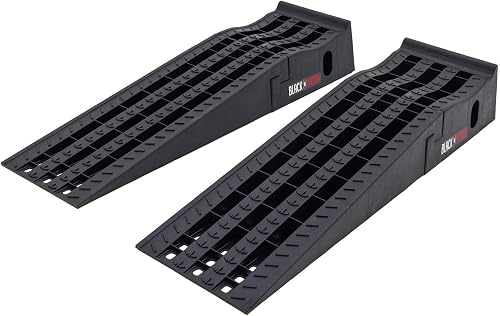
Black Widow 6.5 Inch Lift Car Service Ramps: Best for frequent underbody servicing
- 6.5 in lift height
- Two-piece design
- Curved tire stops
- Anti-slip rubber pads
Removable lower sections give you more room to reach beneath the vehicle. The long approaches need floor space, and conflicting load figures require confirmation.
Pros
- Lower sections remove for access
- Rubber pads help resist sliding
- Open grid lets debris pass through
Cons
- Long assembled footprint
- Load limits need confirmation
The Black Widow ramps suit frequent underside work where removing the lower approach sections would make reaching components easier. Their polyurethane construction also suits a service area, with Black Widow describing resistance to wear from service oils.
Each ramp measures 52 x 15 x 8.25 in, with a 6.5 in lift and a 9.5-degree approach. Allow enough room to line up straight before the tires begin climbing.
Curved stops help mark the tire's resting position, while rubber pads help resist sliding. The open channel grid lets water and loose debris pass through, but check beneath the base before loading it.
Choose this pair if removable approaches will help on most jobs and you have room for the assembled length. Skip it for a cramped work area or until the conflicting vehicle, axle and ramp capacity figures are resolved.
Keep the removed pieces outside your exit path so they don't become obstacles while you're working.
TOWKING 16000 lb Stackable Car Ramps: Best for taller vehicle maintenance
- 7.3 in lift height
- 16,000 lb pair capacity
- Stackable design
- 18 rubber base pads per ramp
The tallest lift here suits vehicles with enough front clearance to climb the steeper approach. Stacking helps when the ramps return to storage.
Pros
- Tallest lift in this group
- Stackable design
- Raised front stop blocks
Cons
- Steep approach can rule out low cars
- Tire fit still needs checking
TOWKING suits vehicles with enough front clearance to use the tallest lift in this group. Its 7.3 in platform height may help when a lower pair leaves too little space for your chosen task.
The tradeoff is a 17-degree incline. A taller truck or SUV may suit that profile, but ground clearance alone doesn't confirm that its bumper, steps or other low parts will clear.
The polypropylene pair has a stated 16,000 lb capacity, with 18 rubber base pads per ramp. Raised front stop blocks give a positioning cue; approach them slowly rather than using them to stop forward momentum.
Choose TOWKING when the extra lift solves a measured space problem and the vehicle clears the approach. Skip it for a low front lip or if a shallower pair already provides the room you need.
The ramps stack for storage, so keep them nested rather than loose across the garage floor.
How to choose car ramps that fit your vehicle
Check capacity, tire fit and approach clearance before choosing lift height. A ramp that fails any of those checks is unsuitable even if it offers more space underneath.
How do you check the best car ramps for load capacity?
Read each limit in the ramp instructions and keep its meaning intact. A pair rating doesn't allow either individual ramp to exceed its own limit.
A gross vehicle weight limit applies to the vehicle, while an axle limit concerns the load carried by that axle. Neither should be substituted for a separately stated ramp or pair limit.
Don't divide the vehicle's weight equally among 4 wheels. Engine position, cargo and vehicle design affect weight distribution, and the setup must meet every applicable equipment limit.
Confirm compatibility using the vehicle and ramp instructions before loading. An unclear capacity isn't a gap to fill with guesswork or a reason to choose the largest number.
Will your tires sit fully on the platforms?
Usable tire width matters more than outside ramp width. Raised edges, handles and side walls can occupy part of the overall measurement.
Check the actual tires fitted to the vehicle, especially if wheels or tires differ from the original size. The tread must sit correctly on the platform within the ramp maker's tire-fit limits.
Also check that both tires can line up with the ramps at the same time. A pair placed too close together or too far apart can leave a tire riding an edge.
How much lift does your job need?
Measure the space needed for your body, tools and the component you're reaching. A drain plug may be accessible while the filter remains blocked by a crossmember or splash shield.
A creeper adds height beneath your body, and a drain pan needs room to slide into position. Plan those items before choosing a taller ramp solely for comfort.
Lift height describes how far the supported tires rise, not a uniform increase beneath every part of the car. Raising one end tilts the vehicle, so clearance varies along its underside.
For an oil change, also check the vehicle's draining and oil-level instructions. A tilted vehicle may need to return to level ground before you can get the required final reading.
Will the front end clear the approach?
Check the front lip, bumper overhang and full ramp profile together. A low lip far ahead of the tire can contact the ramp before the wheel begins climbing.
Look beyond the first contact point. Splash shields and other low parts must clear as the tires move toward the platform.
A shallower approach can help, but no single angle guarantees fit for every low car. Use only approved extensions, and never bridge a clearance problem with loose boards or improvised blocks.
How to set up car ramps before going underneath
Use a hard, level, load-bearing surface allowed by the ramp instructions. A high load capacity or rubber base cannot make soft, sloped or oily ground suitable.
The MaxxHaul 50709 specifically excludes dirt, grass, sand, gravel and other loose or unstable surfaces. Apply the exact surface restrictions for whichever pair you choose.
Prepare the work area and vehicle
Clear the whole approach path, not just the space beneath the ramps. You need room to align the vehicle, climb slowly and drive off without turning sharply.
Inspect the ramps for cracks, distortion, damaged joints or missing grip parts. For a sectional design, assemble and seat every connection before moving the vehicle toward it.
Place the ramps in line with the tires and check that each base rests fully on the floor. If a ramp rocks or sits partly over a floor joint, reposition the setup before loading.
Keep people, pets and loose tools away from the vehicle's path. A helper can watch alignment from a safe position to the side, with an agreed signal to stop.
Drive on slowly and check the resting position
Follow the vehicle and ramp instructions for loading, using slow, controlled movement. If a ramp slides or the car touches it, stop and correct the cause.
Don't add throttle to force a reluctant vehicle up the approach. More momentum makes it harder to stop at the correct position and can push the ramps forward.
Once parked, secure the vehicle with the specified gear or transmission position, parking brake and wheel chocks. Shut the engine off for ordinary underside maintenance and check that both tires rest correctly on their platforms.
Inspect the setup from outside before entering the space beneath the car. Confirm that the ramps remain aligned and stable, and that no tire overhangs an edge.
Plan the exit before starting the job
Keep tools, drain pans and removed approach sections out of the drive-off path. If the instructions permit detaching sections, follow their required removal and reattachment sequence.
Before lowering, make sure nobody is beneath or behind the vehicle. Remove the securing equipment in the instructed order and drive off slowly, keeping the tires aligned with the ramps.
Common car ramp mistakes to avoid
The most serious mistakes are loading an unsuitable setup and continuing after it moves. Stop when anything shifts, binds or contacts the vehicle.
- Using a storage stack as a lifting stack: Nesting ramps saves space between jobs; it doesn't authorize driving onto stacked ramps.
- Trusting a front stop to absorb speed: Stops help with positioning, but controlled driving must bring the car to rest.
- Treating grip features as a surface fix: Rubber pads and tire ribs don't make oil, loose ground or a slope acceptable.
- Removing a supported wheel: A ramp supports the tire resting on it, so it cannot support that corner once the wheel is lifted away.
- Assuming RV compatibility covers every axle arrangement: Raising one tire on a tandem setup can change the load on nearby components.
- Reaching beneath the car before securing it: Parking on the platforms is only one step in the support process.
Don't use a pair with mismatched models or damaged replacement sections. Components that appear to fit together still need approval for that exact configuration.
How to clean, inspect and store car ramps
Clean contact surfaces and inspect the structure before every use. Oil on the tire path or debris beneath the base can undermine a carefully aligned setup.
Wipe away spills promptly using a cleaning method allowed for the material. Avoid unapproved solvents, and let the ramps dry before putting them away.
Look closely at the platform, underside, approach and any connecting tabs. Remove a ramp from service if it is cracked, distorted or missing required parts.
Store the pair away from damaging heat, chemicals and impacts, following the manufacturer's directions. Don't pile heavy equipment on top of ramps unless their storage instructions allow it.
Keep removable sections and approved extensions together so the next assembly is complete. Recheck the instructions when changing vehicles or returning to ramps after a long storage period.
Car ramps or a floor jack: which works better?
Ramps suit wheel-on work; a jack and suitable stands suit jobs requiring wheel removal. Choose around the repair rather than trying to make one support method cover every task.
Ramps can provide direct access for an oil change or inspection when the tires remain supported. They may also leave an approach section in the path of your body or tools.
A floor jack lets you lift at designated points, but it isn't sufficient support for working underneath. The vehicle needs the approved support arrangement before you enter that space.
For brake work, tire removal or suspension tasks, confirm which points must carry the vehicle and whether the suspension must hang free. Our car ramps vs jack stands comparison explains the practical differences.
If the task calls for stands, the jack stands for cars guide can help you compare the support equipment separately.
Can you use car ramps with jack stands?
Combine ramps and stands only when the vehicle and equipment instructions allow the exact arrangement. Adding another support device doesn't automatically improve the setup.
Lifting another part of the car can change loads and move tires on the platforms. A tire that leaves its ramp is no longer supported by that ramp.
Stands need approved support points, suitable capacity and the correct floor surface. Don't put them beneath convenient-looking parts or use them to compensate for an unsuitable ramp.
Plan the full lifting sequence before starting, including how the vehicle will return to the ground. Our guide to using jack stands with car ramps covers the questions to settle first.
Which car ramps should you buy?
Buy the MaxxHaul 50515 for routine home maintenance when its fit checks pass. Choose the 50947 if carrying and storing the pair after every job matters most.
For a lowered car that needs jack access, choose the Tomioka Super Slopes after confirming capacity. Choose the MaxxHaul 50709 when removable approaches solve a reach problem, or consider Black Widow for the same access need once its load limits are clear.
TOWKING makes sense when extra lift is necessary and your vehicle clears its steeper approach. Keep Florety on the shortlist only after its capacity basis and dimensions are confirmed for your RV or other vehicle.
The best car ramps are the pair that fit your vehicle and your actual repair. Before the first use, work through are car ramps safe? so alignment, surface and securing checks are part of the job.
Our top 3 picks at a glance
-
1
Best for everyday garage maintenance
MaxxHaul 50515 Car Ramps, 6.25 Inch Lift
8.9/10 our score
See it on Amazon -
2
-
3
Best for flexible underbody access
MaxxHaul 50709 Extendable Car Ramps
8.1/10 our score
See it on Amazon
Frequently asked questions
How much lift do car ramps provide?
These picks provide about 2.56 to 7.3 in of lift. Choose enough room for your body, tools and drain pan, while checking that the vehicle can clear the approach.
Compare the tire platform's lift height rather than overall ramp height, which may include raised stops or other parts.
Are car ramps safe for oil changes?
Car ramps can support oil-change work when the vehicle, load limits, tire fit and setup meet the equipment instructions. Use a suitable hard, level surface and secure the vehicle before going underneath.
Our car ramp safety guide explains the position and stability checks to make before starting.
Can low cars use car ramps?
Low cars can use ramps if the bumper, lip and underside clear the full approach. A shallow incline helps, but front overhang and the ramp's shape also affect fit.
Measure before buying, avoid improvised extensions and use our car ramps for low cars guide to work through the clearance checks.
Do you need jack stands with car ramps?
Jack stands are not automatically required for every ramp-supported task; follow the vehicle and equipment instructions. If a wheel is lifted off its ramp, that ramp no longer supports it.
Never work beneath a vehicle supported only by a floor jack; read when to use jack stands with ramps before combining equipment.